

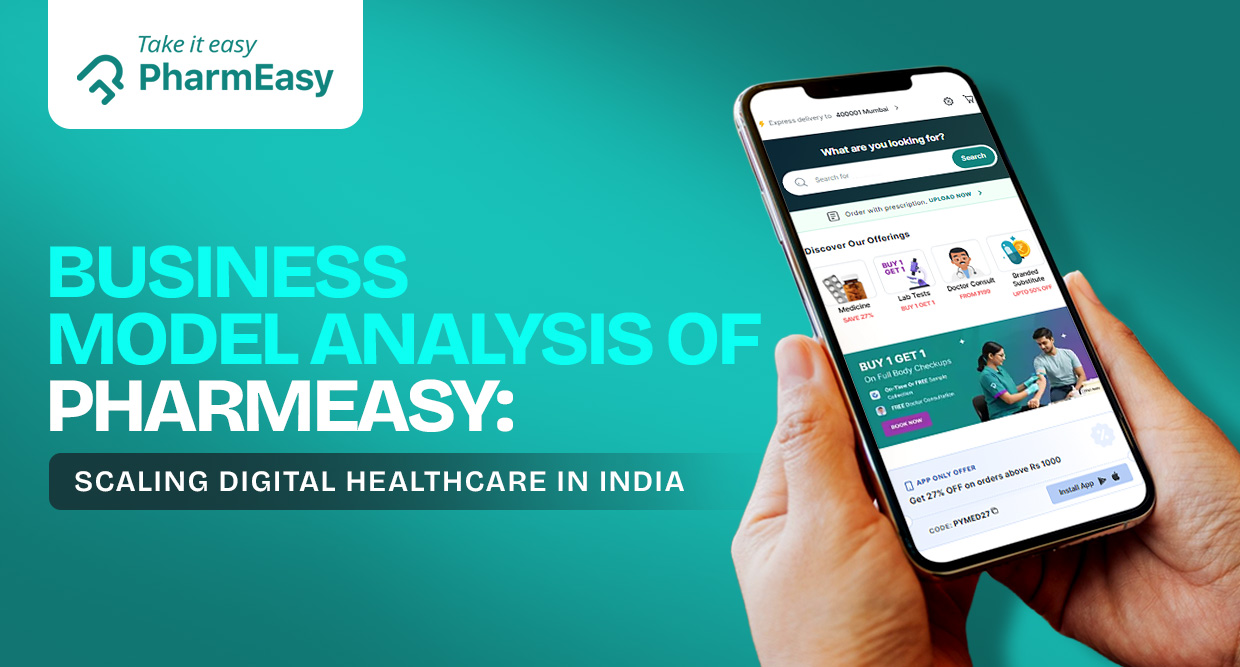
India’s healthcare retail sector has long been complex and highly fragmented. With over 800,000 standalone brick-and-mortar pharmacies, consumers historically faced issues like unpredictable drug availability, price opaqueness, and quality concerns.
Enter the e-pharmacy revolution around 2014 -15. Among dozens of startups, PharmEasy emerged as a pioneer, becoming India’s first e-pharmacy unicorn in 2021. Founded by Dharmil Sheth and Dr. Dhaval Shah in Mumbai, the company transformed how Indians buy medicine. However, its trajectory from rapid scaling to financial restructuring offers profound lessons for digital marketers and corporate strategists alike.
This PharmEasy case study unpacks the brand's business model, disruptive marketing frameworks, aggressive growth strategy, and the critical intersection where digital marketing meets financial sustainability.
At its inception, the core PharmEasy Business Model relied on a highly scalable, asset-light marketplace strategy. Instead of tying up immense capital in purchasing and warehousing medicine inventory, PharmEasy built a digital bridge connecting consumers with verified local brick-and-mortar pharmacies.
When scaling digital healthcare in India, the primary barrier was not operational; it was psychological. Consumers harbored deep skepticism about buying medicines online, anxious about counterfeit products, erratic delivery timelines, and whether steep digital discounts were genuine.
While conventional healthcare players sought consumer trust through clinical authority, doctors, and sober certifications, the PharmEasy Marketing Strategy took an unconventional route: reassurance through relaxation and humor.
PharmEasy unified its brand voice under the memorable tagline "Take It Easy, PharmEasy." The creative strategy evolved across three distinct phases:
To solidify market dominance and ward off emerging ecosystem threats, the PharmEasy Growth Strategy transitioned from organic user acquisition to aggressive, debt-financed consolidation.
Through this rapid infrastructure expansion, PharmEasy shifted its positioning from a simple e-pharmacy to a full-stack digital healthcare ecosystem offering medicines, diagnostic booking, and teleconsultations.
While the PharmEasy Growth narrative was highly compelling to consumers, the financial underpinnings faced structural headwinds by 2022-2024.
The $613 million Thyrocare acquisition was heavily funded via debt, including a $285 million loan from Goldman Sachs. As macroeconomic conditions shifted post-pandemic, digital health platforms experienced normalizations in demand. Thyrocare’s market capitalization decreased, causing PharmEasy to breach certain loan covenant terms.
The PharmEasy journey serves as an essential case study for understanding the boundary lines between excellent marketing and business model execution:
Also Read: Brand Positioning in Marketing Strategy: Concept, Role & Importance
Analyzing complex corporate narratives like the PharmEasy case study highlights how rapidly digital marketing intersects with data analytics, consumer psychology, and corporate growth frameworks. If you want to master these modern business ecosystems and learn how to build resilient, data-driven brand architectures, choosing the right management program is your crucial first step.
The Bengal Institute of Business Studies stands out as the premier MBA college in Kolkata, offering a state-of-the-art learning platform designed for the digital age. Through the specialized BIBS MBA in Digital Marketing Course, students actively analyze real-world market distributions, dissect consumer habits, and gain hands-on experience under the mentorship of top industry leaders.
Recognized widely as providing the Best MBA in Digital Marketing, BIBS equips young professionals with advanced skills in growth hacking, SEO, performance marketing, and digital brand management. Transform your career and learn to steer brands from initial scaling to sustainable profitability by joining the top-tier management cohort at BIBS Kolkata today.
PharmEasy initially utilized an asset-light marketplace model connecting local brick-and-mortar pharmacies with online consumers. It later expanded into a full-stack digital healthcare provider by acquiring Thyrocare to integrate diagnostic testing alongside medicine delivery.
Instead of defaulting to clinical talk or dry health advice, PharmEasy deployed an unconventional humor-led strategy. Through campaigns like "Dance Easy" and partnerships with Aamir Khan, they turned buying anxieties into relatable comedy, easing consumer friction.
PharmEasy’s rapid expansion was heavily debt-financed, notably its ₹4,546 crore acquisition of Thyrocare. Post-pandemic market corrections and rising capital costs compressed its valuation, leading to an IPO withdrawal and a strategic shift toward cutting net losses.
PharmEasy competes in a highly consolidated market against conglomerate-backed ecosystems, including Tata 1mg, Reliance Netmeds, Amazon Pharmacy, and Apollo 24x7.

Posted on May 26, 2026
Categories Digital Marketing
Copyright - BIBS Kolkata
| Website by Marko & Brando
All rights reserved