

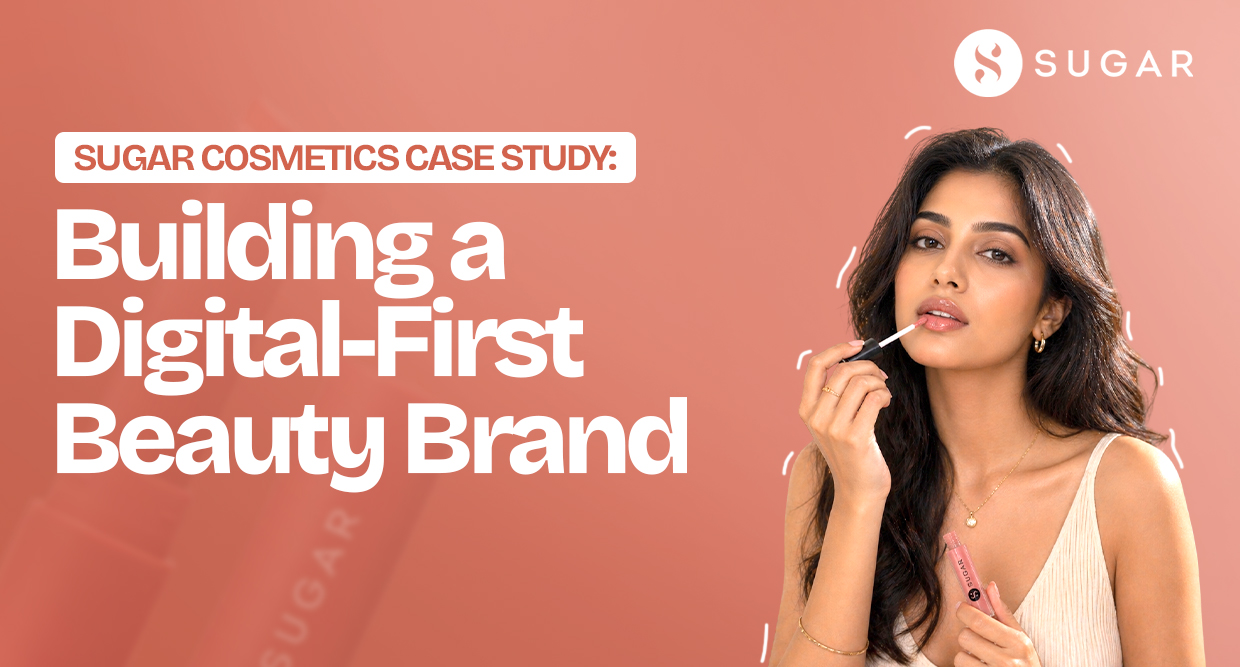
The Indian beauty industry was long dominated by legacy giants until a "bold, low-poly packaged" disruptor entered the scene in 2015. Founded by Vineeta Singh and Kaushik Mukherjee, Sugar Cosmetics didn't just sell makeup; it sold an identity. This case study explores how Sugar Cosmetics leveraged a digital-first approach to become one of India’s fastest-growing premium beauty brands.
Sugar Cosmetics started at a time when the Indian market was saturated with international brands that often ignored the specific needs of Indian skin tones. By focusing on high-pigment, long-lasting formulas tailored for a humid climate, Sugar carved a niche. Today, it has expanded from just two products (an eyeliner and a kohl pencil) to over 450+ SKUs, proving that a deep understanding of the consumer is the ultimate growth lever.
Interestingly, the Sugar Cosmetics business model didn't start with manufacturing. The founders initially ran FabBag, a beauty subscription service.
The core of the Sugar Cosmetics marketing strategy lies in "content before commerce."
The Sugar Cosmetics brand strategy is built on being bold and inclusive.
The Sugar Cosmetics growth strategy involved a disciplined "step-by-step" expansion:
The Sugar Cosmetics success story is a testament to the power of agility. By staying close to the consumer through social media feedback loops, the brand can launch a new product or pivot a campaign faster than any legacy competitor. Their revenue growth from a few crores to a multi-hundred crore enterprise highlights the effectiveness of a data-backed, community-led brand.
Check Out: Viral, Visual, Valuable: How Birds of Paradyes Captured Gen Z Attention Online
The success of Sugar Cosmetics provides a blueprint for modern entrepreneurship. It proves that in the MBA in digital marketing, distribution is no longer the only moat; brand resonance and customer data are the real assets. For students at BIBS (Bengal Institute of Business Studies), this Sugar Cosmetics marketing case study serves as a real-world example of how to merge traditional business fundamentals with cutting-edge digital marketing.
Advance Your Career with BIBS, Kolkata. Are you inspired by the growth of D2C brands? At BIBS, the premier MBA college in Kolkata, we offer a specialized MBA in Digital Marketing that equips you with the skills to build the next big brand. Learn from industry leaders, work on live projects, and master the strategies that fuel success stories like Sugar Cosmetics. Join BIBS today and transform your future.
Sugar focuses on a "digital-first" approach, utilizing influencer collaborations, educational social media content, and inclusive branding to reach Gen Z and Millennial consumers.
It was founded in 2015 by Vineeta Singh and Kaushik Mukherjee, initially launching with just two products after gaining consumer insights from their subscription venture, FabBag.
It uses an omnichannel approach, combining a strong D2C online presence with extensive offline retail distribution across India.
Because it disrupted a market dominated by global giants by offering high-quality, long-lasting products specifically formulated for Indian skin tones at an accessible premium price point.
BIBS is a top-ranked MBA college in Kolkata offering specialized programs in Digital Marketing and Management.

Posted on Apr 28, 2026
Categories Digital Marketing
Copyright - BIBS Kolkata
| Website by Marko & Brando
All rights reserved